Park

Park
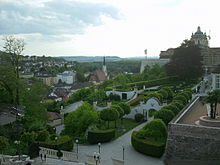
Parkanlage des Stiftes Melk
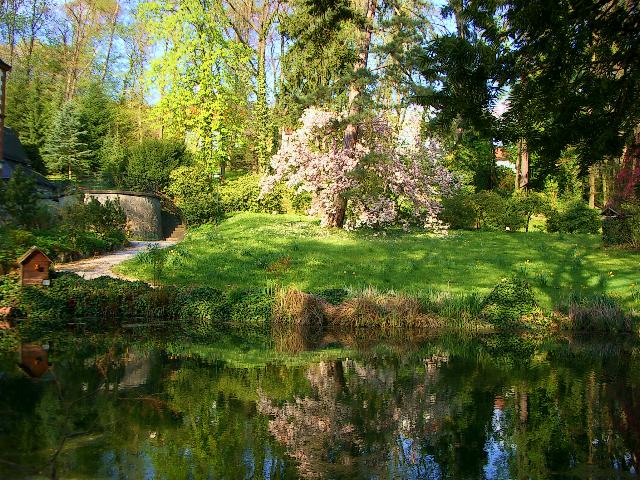
Parkanlage der Villa Haas

Das Wort Park (von mlat. parricus „Gehege“) bezeichnet nach den Regeln der Gartenkunst gestaltete größere Grünflächen, die der Verschönerung und der Erholung dienen.

Parks wurden zunächst meist außerhalb von Städten, oft als Schlosspark, Tiergarten, („Wildpark“) mitunter auch als Jagdgarten, großflächige Landschaftsgartenanlagen angelegt. Beispiele hierfür sind der sogenannte „französische Park“ im geometrisch-regelmäßigen Stil oder der „englische Landschaftspark“ im naturähnlich-unregelmäßigen Stil.

Pückler-Muskau verfocht die Idee, dass der Park nur den „Charakter der freien Natur und Landschaft haben darf“. Der sei eine idealisierte Natur und suche die schönsten nachbildungsfähigen landschaftlichen Bilder auf einem begrenzten Raum zu vereinigen.

Wohl berechnete der Parkgestalter die Baumverteilung und Farbenmischung, dennoch durften die Eingriffe menschlicher Hand nur an den Wegen und Gebäuden sichtbar sein. Blumenverzierungen auf Beeten sind im Park ausgeschlossen; gleichwohl sollen Blumen mehr als in der freien Natur Wälder, Gebüsche, Wiesen und Gewässer schmücken, jedoch so, dass die künstliche Anpflanzung nicht bemerkt wird.

Der Park ist ein großer Garten im natürlichen Stil, aber nicht alle Gärten dieses Stils können Park genannt werden oder sind Parkgärten. Eine ansehnliche Größe des Parks war wünschenswert, aber nicht notwendig. Im kleinen Park wurde der Wald zum Wäldchen und Hain, der See zum Weiher (Teich).

Seit Mitte des 18. Jahrhunderts wurden zunehmend innerstädtische Aufenthalts- und Erholungsgebiete errichtet, etwa Volksgärten, Volksparks und Stadtparks (siehe: Volksgarten) sowie Stadtwälder.

Die Funktion von Wäldern und Parks als „Grüne Lungen“ gilt besonders in der Nähe von Städten und Ballungsgebieten als besonders wichtig. Das bezieht sich in erster Linie auf die Sauerstoffbildung, aber daneben auch auf die Wirkung als Staubfilter durch die Blätter und Nadeln.

In Deutschland unterscheidet man zudem je nach Fläche Parks mit bestimmtem Status. Geschützte Naturflächen von mindestens 20.000 Hektar mit geringem Schutzgrad und hauptsächlich touristischem Erholungsgebiet werden als Naturpark bezeichnet, ab einer Fläche von mindestens 10.000 Hektar mit mittlerem bis hohem Schutzgrad gelten sie als Nationalparks. Im übertragenen Sinne wird der Begriff auch für großflächige Gebiete benutzt, etwa Landschaftspark und Regionalpark.

Einzelne Formen

Vergleiche auch: Garten

Literatur

  • Schwarz, Angela: Der Park in der Metropole. Urbanes Wachstum und städtische Parks im 19. Jahrhundert. Bielefeld (Transcript) 2005, ISBN 3899423062

Wikimedia Foundation.

Игры ⚽ Поможем написать реферат

Schlagen Sie auch in anderen Wörterbüchern nach:

  • Park — (p[aum]rk), n. [AS. pearroc, or perh. rather fr. F. parc; both being of the same origin; cf. LL. parcus, parricus, Ir. & Gael. pairc, W. park, parwg. Cf. {Paddock} an inclosure, {Parrock}.] 1. (Eng. Law) A piece of ground inclosed, and stored… …   The Collaborative International Dictionary of English

  • Park — Park, v. t. [imp. & p. p. {Parked}; p. pr. & vb. n. {Parking}.] 1. To inclose in a park, or as in a park. [1913 Webster] How are we parked, and bounded in a pale. Shak. [1913 Webster] 2. (Mil.) To bring together in a park, or compact body; as, to …   The Collaborative International Dictionary of English

  • Park — Park, v. i. 1. To promenade or drive in a park; also, of horses, to display style or gait on a park drive. [Webster 1913 Suppl.] 2. To come to a stop [in a vehicle] off of the public road and leave the vehicle standing; typically the motor of a… …   The Collaborative International Dictionary of English

  • Pärk — or Paerk is a game, somewhat similar to tennis, that has been played for centuries on the island of Gotland in Baltic Sea. The game is played with two teams of 7 people on a field that is 30 metres wide and that can vary in length. The players… …   Wikipedia

  • Park — A park is a protected area of land and water, usually in its natural or semi natural (landscaped) state and set aside for some purpose, often to do with human recreation. The natural state consists of various interdependent elements, compounds,… …   Wikipedia

  • Park No-ja — Infobox Korean name hangul=박노자 hanja=linktext|朴|露|子 rr=Bak No ja mr=Pak No ja BiographyPark, No ja (Russian: Владимир Тихонов, 1973 ) was born to a Jewish family in St. Petersburg, Russia. His Russian name is Vladimir Tihonov but after… …   Wikipedia

  • park — I. noun Etymology: Middle English, from Anglo French, from Medieval Latin parricus, from pre Latin *parra pole, trellis Date: 13th century 1. a. an enclosed piece of ground stocked with game and held by royal prescription or grant b. a tract of… …   New Collegiate Dictionary

  • Park Slope, Brooklyn — Park Slope is a neighborhood in the western section of Brooklyn, New York City s most populous borough. Park Slope is roughly bounded by Prospect Park West to Fourth Avenue, Park Place to the Green Wood Cemetery according to the New York City… …   Wikipedia

  • Park Avenue (Manhattan) — Park Avenue (formerly Fourth Avenue) is a wide boulevard that carries north and southbound traffic in New York City borough of Manhattan. Throughout most of its length, it runs parallel to Madison Avenue to the west and Lexington Avenue to the… …   Wikipedia

  • Park golf — (パークゴルフ), a form of golf played in a park, was invented in Makubetsu, Hokkaidō, Japan in 1983. Esthetically, it resembles a sport somewhere between golf and croquet. The competitive object of the game is to hit the ball into a hole with a club in …   Wikipedia

  • Park Hill, Denver — Park Hill is a neighborhood in Denver, Colorado, U.S.A. Located in the northeastern quadrant of the city, it is bordered by Colorado Boulevard on the west, East Colfax Avenue on the south, Quebec Street on the east, and East 52nd Avenue on the… …   Wikipedia

Share the article and excerpts

Direct link
… Do a right-click on the link above
and select “Copy Link”